As a business grows, its marketing operations become more complex. The number of customers increases, communication channels multiply, more teams become involved in marketing and sales, and the volume of data generated across different touchpoints grows rapidly. At that point, managing everything through a few spreadsheets, disconnected tools, and scheduled email campaigns simply stops being practical.
Imagine a potential customer who reads one of your blog posts in the morning, sees your LinkedIn ad at noon, registers for a webinar later that day, and speaks with a sales representative the next morning. If each of these interactions is stored in a different system, no team has a complete picture of that customer’s journey. As a result, someone already in serious discussions with sales may continue receiving introductory nurture emails or be shown offers that no longer match their stage in the buying process.
This is exactly where enterprise marketing automation comes in.
Enterprise marketing automation is not simply a larger version of standard marketing automation software. The goal is not just to send more emails or build more sophisticated workflows. The real challenge is enabling data, teams, channels, and processes to work together within one coordinated system at scale.
The concept has also evolved significantly with the rise of artificial intelligence. Many leading platforms now go beyond rule-based automation and offer capabilities such as predictive analytics, content generation, next-best-action recommendations, and even agentic AI.
So, what exactly is enterprise marketing automation, how does it differ from traditional marketing automation, and what should organizations consider when selecting and implementing a platform? Let’s take a closer look.
What Is Enterprise Marketing Automation?
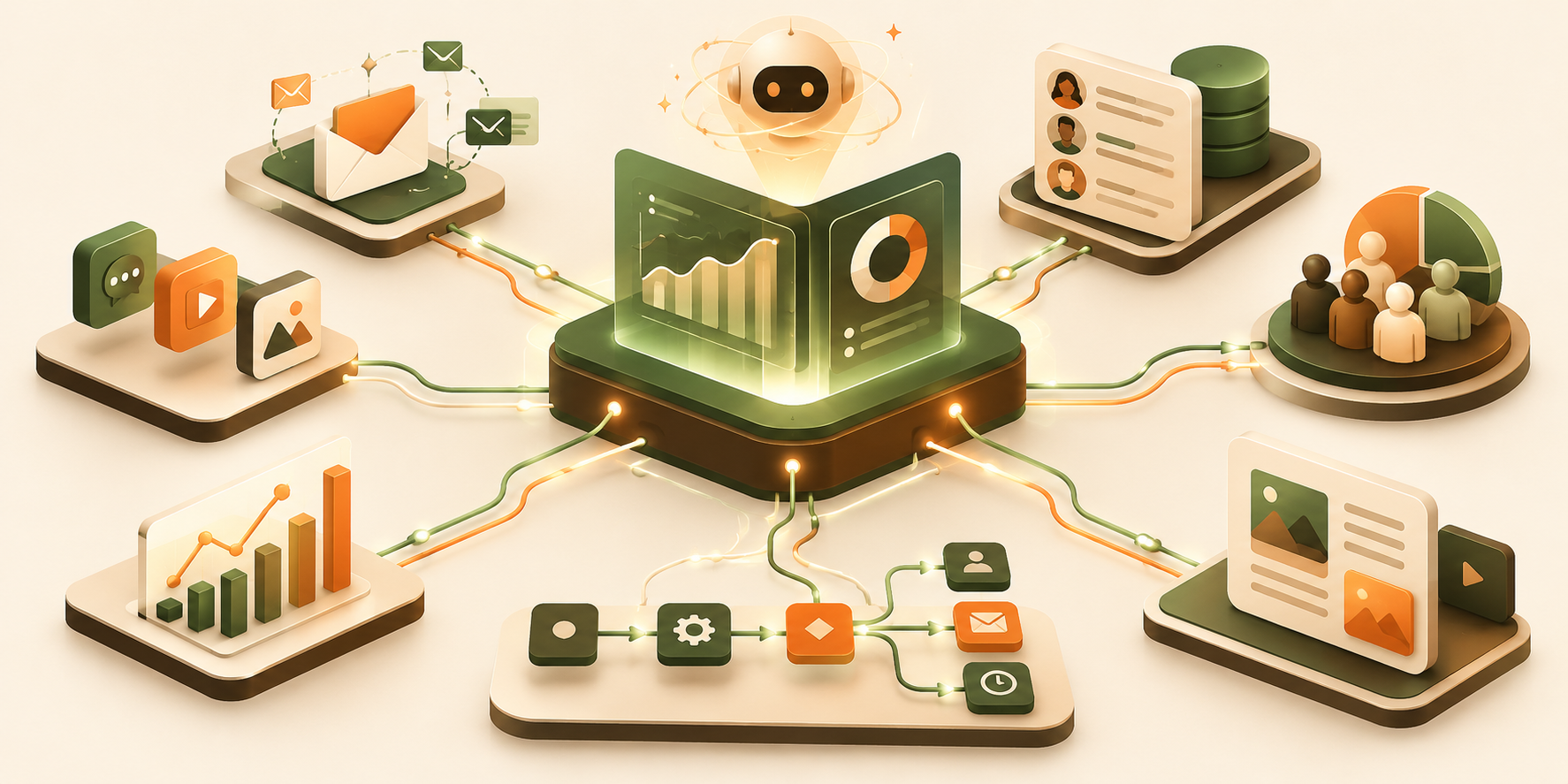
Enterprise marketing automation refers to the combination of technologies, data, and processes that help large organizations automate, coordinate, and personalize their marketing activities at scale.
For a small business, marketing automation might mean sending an automated email after a form submission, segmenting contacts into a few lists, or running a basic lead nurturing campaign. These capabilities are useful, but the situation changes dramatically at the enterprise level.
A large company may operate across multiple countries, manage several brands, and have marketing, sales, and customer service teams interacting with thousands or even millions of customers and prospects every day. In this environment, automating a few repetitive tasks is not enough. The organization needs a system that can connect fragmented data, understand customer behavior across different channels, and trigger the right action based on each customer’s actual situation.
For example, if a prospect has already entered a serious sales conversation, the system should recognize that and adjust marketing communication accordingly. Likewise, if several people from the same company visit pricing pages, read case studies, and review technical documentation within a short period of time, that pattern may signal a meaningful increase in purchase intent.
At its core, enterprise marketing automation is not simply about sending messages automatically. It is about creating a connected flow between data, decisions, and actions.
Enterprise Marketing Automation vs. Traditional Marketing Automation
At first glance, a traditional marketing automation tool and an enterprise platform may appear to offer many of the same capabilities. Both can send emails, segment audiences, build workflows, and score leads.
The real difference becomes clear when the scale and complexity of operations increase.
| Criteria | Traditional Marketing Automation | Enterprise Marketing Automation |
|---|---|---|
| Data structure | Primarily contact records and audience lists | Relationships between contacts, accounts, deals, campaigns, and other data objects |
| Scale | One team or a small to mid-sized business | Multiple teams, countries, brands, or business units |
| Access control | Relatively simple | Roles, permissions, approval workflows, and audit trails |
| Personalization | Based mainly on individual contact attributes | Based on behavior, account data, buying stage, and multiple data sources |
| Channels | Primarily email and web | Email, web, advertising, SMS, apps, and other channels |
| Reporting | Leads and conversions | Pipeline, attribution, and revenue |
| Integrations | Connections to a limited number of tools | Deep integration with CRM, data platforms, sales, and service systems |
| Change management | Often direct publishing | Testing environments, approvals, and governance |
Put simply, the difference is not just about the number of features. It is about how effectively the platform can manage complexity.
Two platforms may both support workflow automation, but managing a workflow in a five-person team is very different from managing the same workflow in an organization with hundreds of users across multiple countries. In the latter case, the company needs to know who can create the workflow, who is allowed to edit it, who must approve it before launch, and how changes can be traced if something goes wrong.
Why Do Large Organizations Need Enterprise Marketing Automation?
Growth almost always brings operational complexity. Over time, individual teams tend to choose the tools that work best for them. Sales uses one CRM, marketing runs email campaigns through another platform, advertising data lives somewhere else, and customer service stores its information in yet another system.
The result is often a collection of data silos, each offering only a partial view of the customer.
Adding another tool does not necessarily solve the problem. If systems are not properly connected, a new platform may simply create another silo.
One of the most important functions of enterprise marketing automation is to bring these disconnected pieces together.
When contact data, company information, sales opportunities, and marketing interactions are managed within a coordinated structure, the system can make far more informed decisions. For instance, if an account has entered an active sales negotiation, certain nurturing campaigns can automatically stop. On the other hand, if several decision-makers from the same company suddenly engage with high-intent content, the system can identify that shift and alert the sales team.
This is why the real value of enterprise automation appears when different parts of the organization stop viewing the customer in isolation.
Key Features of Enterprise Marketing Automation
A platform does not automatically become suitable for large organizations simply because the word “enterprise” appears in its name. What matters is whether it can genuinely handle the complexity of the business.
Below are some of the most important capabilities to consider when evaluating an enterprise marketing automation platform.
Data and CRM Integration
Almost every advanced marketing automation capability depends on one thing: reliable data.
If the CRM stores one version of a customer record, the email platform stores another, and the advertising system contains conflicting information, neither personalization nor reporting can be trusted.
A strong enterprise platform should be able to connect data across contacts, accounts, deals or opportunities, and marketing activities.
However, simply having an integration is not enough. Organizations should also look at how frequently data is synchronized, whether the connection is one-way or two-way, and what happens when the same record contains conflicting information across different systems.
In practice, many automation problems do not begin with poorly designed workflows. They begin with inconsistent data.
Multichannel Campaign Management
Customers do not move through the buying journey in a single channel.
A user may discover your website through Google Search, see a retargeting ad a few days later, open an email, and eventually speak with a sales representative.
If each interaction is analyzed separately, the organization only sees fragments of the customer journey.
A strong enterprise marketing automation platform should treat these touchpoints as parts of a single journey. The real value of a multichannel approach is not simply being present in more places. It is allowing activity in one channel to influence what happens in another.
For example, someone who booked a product demo today should not receive an introductory email tomorrow explaining what the product is.
At enterprise scale, maintaining that level of coordination can make a meaningful difference in customer experience.
Personalization at Scale
Personalization has moved far beyond inserting a customer’s first name at the beginning of an email.
In an enterprise system, content can be adapted based on factors such as industry, job role, past behavior, funnel stage, products used, and even account-level information.
Imagine two executives from the same company showing interest in the same product. One is a finance leader and the other works in IT. They may be evaluating the same solution, but their priorities are likely to be very different.
The finance leader may care most about cost, ROI, and pricing structure. The technology leader may focus more on architecture, security, integrations, and technical compatibility.
A capable enterprise platform should be able to create a more relevant experience for each person without forcing the marketing team to manually build hundreds of separate campaigns.
Lead Scoring and Buying Group Management
In B2B sales, large purchases are rarely made by one person. Executives, technical specialists, finance teams, procurement departments, and even legal teams may all influence the final decision.
That means evaluating each lead in isolation can produce a misleading picture.
Imagine one contact showing only moderate engagement while four other people from the same company are actively viewing pricing pages, reading case studies, and reviewing technical documentation. If every contact is scored separately, none of them may appear particularly important. But when their behavior is viewed at the account level, the buying intent becomes much more obvious.
This is also why account-based marketing, or ABM, relies heavily on account-level engagement rather than individual lead activity alone.
The objective is not only to identify a promising lead, but also to understand how the overall buying group is behaving.
Governance, Access Control, and Publishing Management
One of the biggest differences between enterprise systems and smaller tools appears in an area that is rarely the most exciting part of a product demo: governance.
When hundreds of people use the same system, it does not make sense for everyone to be able to edit every workflow, access every dataset, or launch every campaign.
Roles and permissions need to be clearly defined. Some users may only need access to one geographic market. Others may be allowed to edit campaigns but not publish them. Certain campaigns may require approval from another team before going live.
This is where capabilities such as permissions, approval workflows, and audit logs become essential.
The importance of governance grows even further in organizations that manage multiple brands, teams, or regions. Without the right structure, complexity can quickly become unmanageable.
Brand and Marketing Asset Management
Consider a company operating in 15 different countries. The central marketing team creates a campaign, but local teams need to adapt it for their own markets and languages.
Without a clear framework, colors, logos, calls to action, messaging, and even legal disclaimers may start to vary across markets, creating an inconsistent brand experience.
This is where shared asset libraries, reusable templates, and the ability to lock certain parts of a campaign become valuable.
A good enterprise system should strike a balance between two seemingly competing priorities: centralized brand control and local flexibility.
Too much centralization can slow teams down, while complete freedom can undermine brand consistency.
Attribution and the Connection Between Marketing and Revenue
One of the oldest and most difficult questions marketing teams face is:
“How much revenue did this campaign actually generate?”
In a complex buying journey, a customer may read several articles, see multiple ads, attend an event, receive email campaigns, and speak with sales several times before making a final decision.
In that context, attributing all revenue to the last click does not provide a complete picture.
Enterprise platforms typically allow organizations to use different attribution models and connect campaign activity with pipeline and revenue. However, one thing is important to remember: no tool can reconstruct data that was never captured properly in the first place.
If marketing and sales activities are not recorded against consistent customer and account records, even the most advanced attribution model will produce unreliable results.
That is why accurate revenue reporting starts in the same place as marketing automation itself: integrated data.
The Role of AI in Enterprise Marketing Automation
Early generations of marketing automation relied heavily on simple “if this happens, do that” rules.
If a contact submits a form, send an email. If they do not open it, send another message three days later. If their lead score passes a certain threshold, alert the sales team.
This type of automation is still useful and will likely remain important for many years. However, artificial intelligence has expanded what automation systems can do.
Today, AI can support content creation and optimization, audience segmentation, customer data summarization, data analysis, behavioral prediction, and next-best-action recommendations.
The next stage of this evolution is agentic AI.
The main difference between an AI agent and a traditional workflow is the level of decision-making freedom involved. A workflow follows a path that has already been designed by a human. An agent, by contrast, can receive a goal, review relevant information, and determine the most appropriate action based on the situation.
That creates significant potential, but it also makes an old problem even more important: data quality.
If a CRM is full of incomplete, outdated, or duplicate records, adding AI does not fix the problem. In fact, it may allow incorrect decisions to be made and executed more quickly.
For that reason, organizations planning to use AI in marketing should address data quality before focusing on advanced AI strategies.
Security and Privacy in Enterprise Marketing Automation
The more information an organization collects about customer behavior, the greater its responsibility for managing that information properly.
This is especially important for companies that process data belonging to users in the European Union. GDPR requires organizations to handle personal data according to principles such as transparency, purpose limitation, data minimization, accuracy, and security.
As a result, enterprise marketing automation should not only focus on campaign execution. It must also provide a reliable way to manage user consent and communication preferences.
In this environment, the security question is not simply, “Is the data encrypted?”
Organizations need to know who can access certain information, who exported customer data, who changed a workflow, and who approved or published a campaign.
Capabilities such as permission management, SSO, audit logs, approval workflows, and consent management should therefore not be treated as optional IT features. They are part of the core marketing infrastructure in an enterprise environment.
How to Implement Enterprise Marketing Automation
Buying software is often the easiest part of the process. The real challenge begins when an organization tries to integrate it into day-to-day operations.
One common mistake is attempting to move every existing process into a new platform without first reviewing whether those processes still make sense. When that happens, old problems are not solved. They are simply migrated to a new system.
A more effective approach is to implement enterprise marketing automation step by step.
1. Start With Your Data
Before building any workflow, identify where the data comes from, which duplicate records exist, how fields are structured, and which system will serve as the primary source of truth.
Skipping this step almost guarantees problems later.
2. Design Governance Before Automation
Before teams start building campaigns, roles, permissions, approval processes, and data ownership should be clearly defined.
This may feel slower at the beginning, but it prevents a significant amount of confusion later on.
3. Design Integrations Carefully
Connecting two platforms is not enough.
You need to determine which data should move between systems, the direction of synchronization, how frequently records should update, and what should happen when conflicting information appears.
4. Start With a Pilot Project
Rather than migrating every campaign at once, start with a limited use case.
A pilot allows the team to identify problems with data, integrations, or workflows with much lower risk.
5. Scale After Validation
Once the first process is working reliably, expand the system to additional teams, markets, and use cases.
Ultimately, the success of an enterprise automation project depends less on software alone and more on the alignment of data, processes, and people.
How to Choose the Right Enterprise Marketing Automation Platform
Comparing enterprise software purely by counting features is rarely a good strategy.
On paper, two platforms may appear almost identical. In practice, the way they implement those capabilities can be very different.
For example, both platforms may claim to support CRM integration. One may synchronize data almost in real time, while another updates records in scheduled batches. One may have clear conflict-resolution logic, while the other may require custom development.
The same principle applies to AI, reporting, permissions, and other enterprise features.
A better approach is to bring your real business scenarios into vendor demos.
Ask the vendor to show how a lead moves from initial engagement to opportunity creation. Review what different users can and cannot access. Look at how CRM data flows into campaigns and how marketing activity is ultimately connected to revenue.
Several well-known platforms are commonly included in enterprise evaluations.
HubSpot Marketing Hub Enterprise
HubSpot has continued to expand its enterprise capabilities in recent years, bringing marketing, CRM, sales, service, content, and data tools into a relatively integrated ecosystem.
For many organizations, one advantage of this structure is the reduced distance between marketing activity and CRM data. Capabilities such as permission sets, content approvals, and audit logs can also help larger teams maintain control.
For companies that prefer to manage a significant portion of their marketing and CRM operations within one ecosystem, HubSpot can be worth evaluating.
Adobe Marketo Engage
Marketo Engage has long been one of the best-known names in B2B marketing automation.
The platform offers extensive capabilities for complex campaigns, segmentation, lead management, personalization, and marketing analytics. More recently, Adobe has also placed greater emphasis on AI and agentic functionality.
Marketo’s flexibility can be attractive for organizations with sophisticated marketing operations. However, that flexibility may also require stronger marketing operations expertise and more careful process design.
Salesforce
Salesforce offers a broad ecosystem of marketing products designed for different use cases.
Capabilities across Data Cloud, journey management, Account Engagement, and newer Agentforce features allow Salesforce to bring data, automation, AI, and customer engagement into a broader ecosystem.
For organizations already using Salesforce CRM and storing a significant amount of sales data within the platform, this overlap can be an important advantage during evaluation.
Oracle Eloqua
Oracle Eloqua is another established platform in B2B marketing automation, with a strong focus on lead management, lead nurturing, segmentation, and complex campaign execution.
For organizations with large-scale B2B processes or companies already using other Oracle infrastructure, Eloqua may be another option worth considering.
Ultimately, selecting among these platforms should not be based on brand recognition or feature count alone. The organization’s existing architecture, CRM, team size, campaign complexity, budget, and governance requirements should all influence the decision.
Common Mistakes in Enterprise Marketing Automation
Automating a poor process does not turn it into a good one. It simply allows mistakes to happen faster.
That is one of the most important principles to keep in mind when building enterprise marketing automation.
If marketing and sales do not agree on what qualifies as a sales-ready lead, automating lead handoff will not solve the disagreement.
If customer records are duplicated or incomplete, advanced lead scoring will not produce reliable results.
If ownership of workflows is unclear, adding AI agents will simply increase the number of decisions that nobody is clearly responsible for.
Another common mistake is trying to automate everything from day one.
In practice, a few simple, transparent, measurable automations often deliver more value than dozens of complicated workflows that nobody fully understands six months later.
Every automation should exist to solve a clearly defined business problem.
How to Measure the ROI of Enterprise Marketing Automation
Saving time is one of the most obvious benefits of automation, but it is usually not enough to justify an enterprise-level investment on its own.
Leadership ultimately wants to know what impact the system has had on business outcomes.
That is why organizations should establish clear baseline metrics before implementation. Conversion rate, marketing-sourced pipeline, sales cycle length, and campaign-generated revenue are all examples of useful indicators.
After implementing enterprise marketing automation, teams can measure whether qualified leads are reaching sales faster, whether conversion rates have improved across key journeys, whether marketing is generating more pipeline, and whether the team is able to handle a larger volume of activity without increasing headcount at the same rate.
Attribution should also be defined before results are analyzed.
If the attribution model changes every time a campaign performs well or poorly, reporting quickly loses credibility. Marketing, sales, and finance teams should agree in advance on how different channels and campaigns will receive credit.
The final goal is not for marketing to show how many emails it sent or how many workflows it built. The more important question is how those activities contributed to the creation, progression, and closing of revenue opportunities.
What Does the Future of Enterprise Marketing Automation Look Like?
The boundaries between CRM, marketing automation, CDPs, and AI platforms are becoming increasingly blurred.
Capabilities that once required several separate tools are gradually being absorbed into larger ecosystems. Identity resolution, account scoring, content generation, predictive analytics, and journey orchestration are all examples of this trend.
As a result, the central question for organizations is likely to shift.
Instead of asking:
“How can we automate this email?”
They may increasingly ask:
“How much of the customer journey decision-making process can we delegate to the system?”
As agentic AI develops, the role of automation may move from executing predefined instructions toward systems that can understand goals, analyze information, and recommend or even execute the most appropriate action.
But greater autonomy also makes governance, data quality, and human oversight more important.
The most successful organization will not necessarily be the one with the most automation. It will be the one that understands which decisions should be automated, which decisions still require human judgment, and what data is needed to support both.
Conclusion: Enterprise Marketing Automation Is More Than Automation
If there is one idea to take away from this discussion, it is that enterprise marketing automation is less about automating individual marketing tasks and more about coordinating the entire marketing ecosystem.
A strong platform should connect CRM data with campaigns, keep customer experiences consistent across channels, enable personalization at scale, and ultimately demonstrate how marketing activity contributes to pipeline and revenue.
Technology, however, is only half of the equation.
Data quality, clearly defined processes, collaboration between marketing and sales, governance, and privacy practices will determine whether automation actually supports business growth or simply creates a more complicated collection of workflows.
That is why, before choosing any enterprise marketing automation platform, it is worth starting with one simple question:
What specific business problem are we trying to solve?
If the answer is clear, choosing the right technology becomes much easier.
If the problem itself is still unclear, even the most advanced enterprise platform or intelligent AI agent cannot define it on the organization’s behalf.